 Jev (TypeSafe AI)
 OpenAI API
 Vercel
 GitHub
 Claude Design
01
Tidey Sorts the Morning
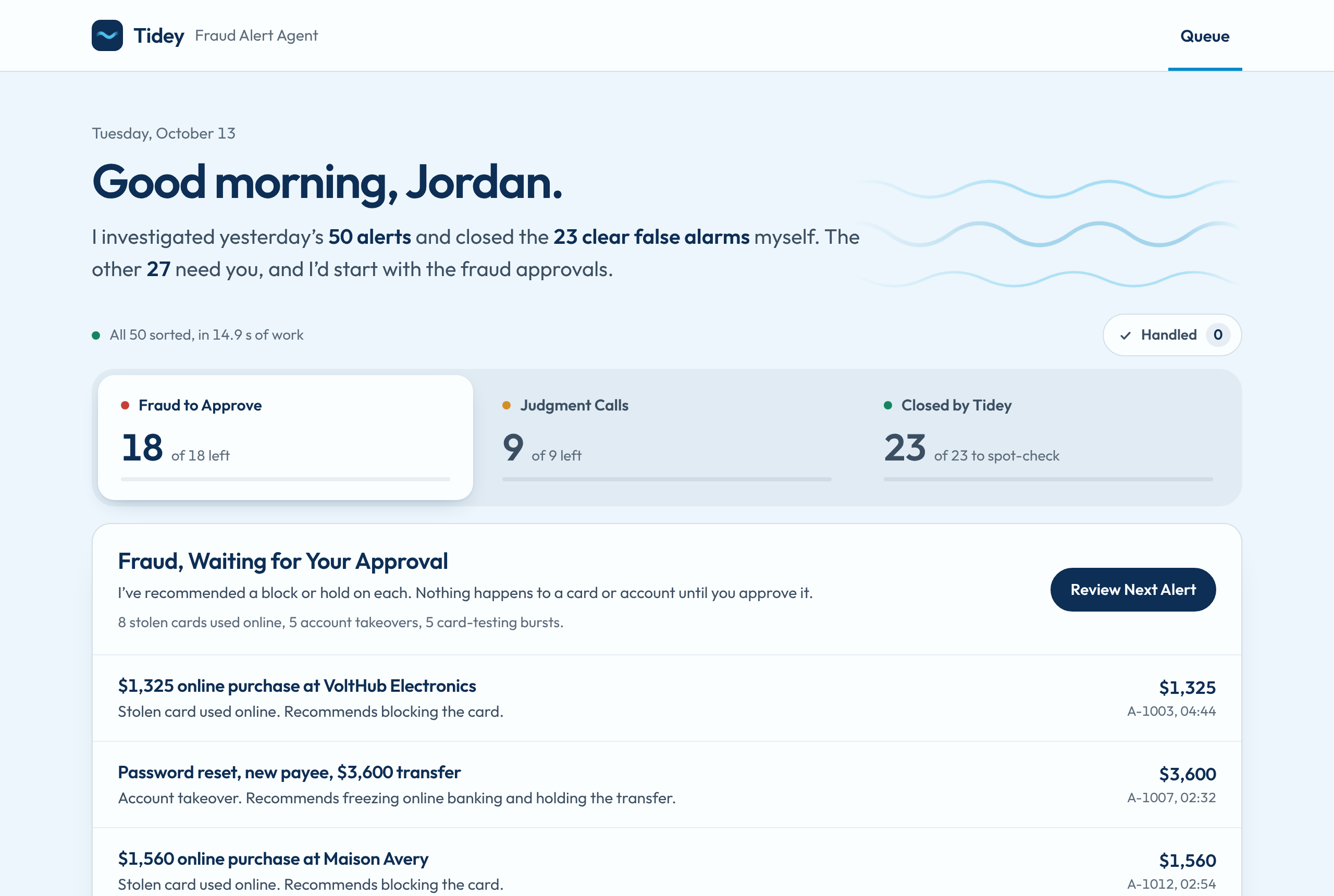
Tidey investigates every alert overnight, closes the clear false alarms and splits the rest into three groups.
Before anyone can decide, someone has to piece the story together: who the customer is, what’s normal for them, what changed and when.
From interviews with fraud teams in North America and Europe (NICE Actimize, 2026). NICE Actimize sells fraud software, so these are vendor figures.
Code does the exact work, Jev makes the judgment calls with probabilities, an AI model writes for people, and a person has the final say.
Any fraud type at 0.85 or higher goes to the fraud team with a recommendation.
Fraud to ApproveAnything that misses a rule, with a summary and a suggested next step.
Judgment CallsLegitimate at 0.85 or higher, nothing unexplained above 0.35, scam risk under 0.6 and under $5,000.
Closed by TideyThe queue says what’s waiting and where to start, and every case ends in one decision bar.
Tidey investigates every alert overnight, closes the clear false alarms and splits the rest into three groups.
An account takeover. Tidey recommends a freeze, and nothing happens until the analyst approves it.
Mixed signals on gift card purchases. Tidey suggests contacting the customer, and the analyst sends the text.
Every alert Tidey closes keeps its evidence. The analyst checks it and confirms the close.
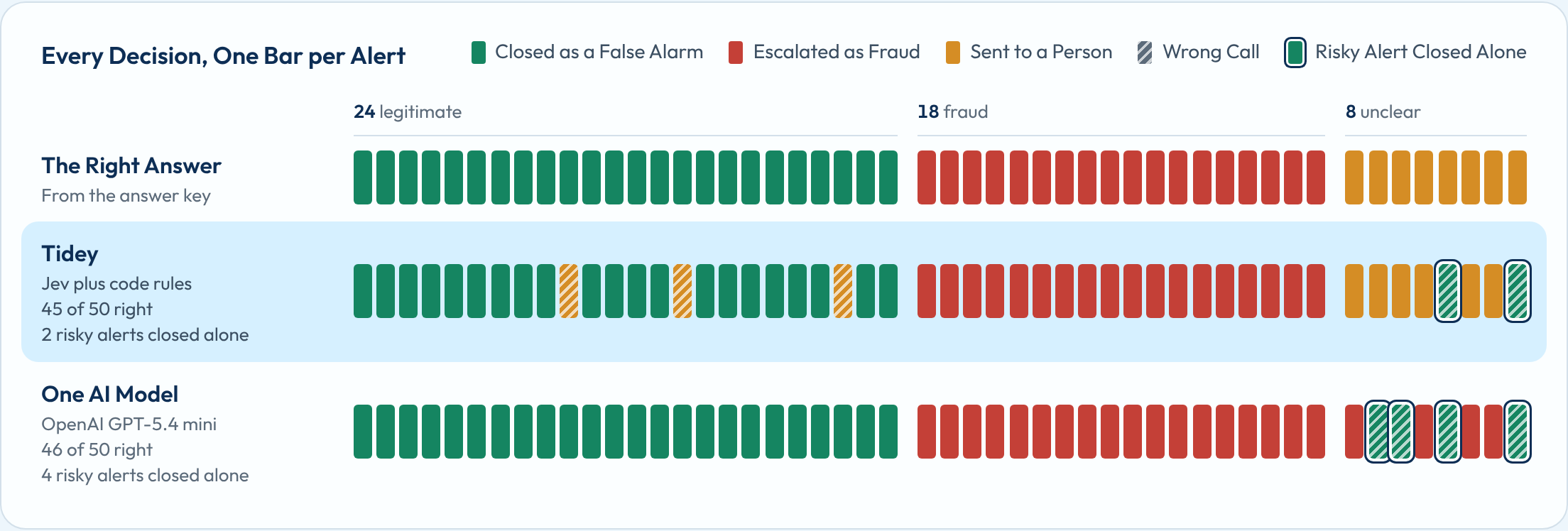
Every decision from the held-out test, side by side with a single AI model.
Six choices shaped how it decides and where a person steps in.
Jev answers narrow questions. Code combines the answers, so each threshold can be read, tested and moved on its own.
Moving where Tidey closes an alert is a one-line change a fraud lead can review, not a prompt rewrite.
Freezing an account hits a real customer and is hard to undo. Tidey recommends and explains; an analyst decides.
However confident Tidey is, large amounts always reach a person. The single model gets the same guardrail.
Required checks always run. Jev decides whether the rest are worth running, which keeps each investigation short.
Closed false alarms keep their evidence but skip the AI-written summary, which is most of the cost.
Two sets of 50 synthetic alerts, each with an answer key neither version sees. Tidey was tuned on the first, then both versions ran once on the second.
My first question was the wrong one: ‘is everything explained?’ Almost nothing is fully explained, so 19 legitimate alerts went to a person.
Turned around to “is anything out of character and unexplained?” One question, 14 more right.
Three legitimate alerts sat just over the 0.30 limit. Moving it to 0.35 replayed at 48 on the tuning set.
Run once on the second set. Nothing was re-tuned after it.
Generated after tuning, with a new seed, new places, merchants and amounts, and 8 new unclear cases.
Tidey trades 3 extra reviews for half the risky closes, at a third of the cost and 7× the speed.
| Measure | TideyJev decides, code acts | One AI modelGPT-5.4 mini, doing everything |
|---|---|---|
| Correct decisions | 45 / 50 | 46 / 50better |
| Fraud closed with nobody looking | 0 | 0 |
| Unclear alerts closed with nobody looking | 2better | 4 |
| Unclear alerts a person saw | 6 / 8better | 4 / 8 |
| Legitimate alerts sent to a person | 3 | 0better |
| Right fraud type when escalated | 18 / 18 | 18 / 18 |
| Cost per alert | $0.0012better | $0.0037 |
| Time to a decision | 0.30 sbetter | 2.2 s |
| Broken or invalid outputs | 0 | 0 |
Official run, October 14, 2026, with Jev (jev-1.13.0) and OpenAI GPT-5.4 mini. Tidey’s cost includes the summary it writes for alerts a person reads.
The points where a person always decides, and the two alerts that got past them.
Both passed every rule. The single model closed them too, plus two more unclear alerts.
A booked trip, but a non-bank ATM at 2:40 AM is a common skimming pattern.
From a new phone that took three tries at two-factor while the old one was still in use.
Code rule: Legitimate 1.00 ≥ 0.85 and nothing unexplained (0.08 ≤ 0.35), so Tidey closed it alone.
Answer key: unclear, a person should look. This decision is wrong.
Decided in 0.29 s for $0.0002.Both misses passed every rule. Jev answered the question it was asked, and for both the customer was a fair answer. The fix is a new question, not a stricter number.
A third question for Jev: “Is this risky even if the customer can explain it?”, for patterns like overnight cash at a non-bank ATM or a new device that failed two-factor. A high answer goes to a person.
Run a fresh held-out set, so the new rules are checked on alerts they weren’t written for.
Calibrate the lines on real labeled alerts, run next to analysts, and measure the minutes saved per alert.
A self-initiated project with synthetic data, built end to end: agent design, analyst app and a head-to-head test.